

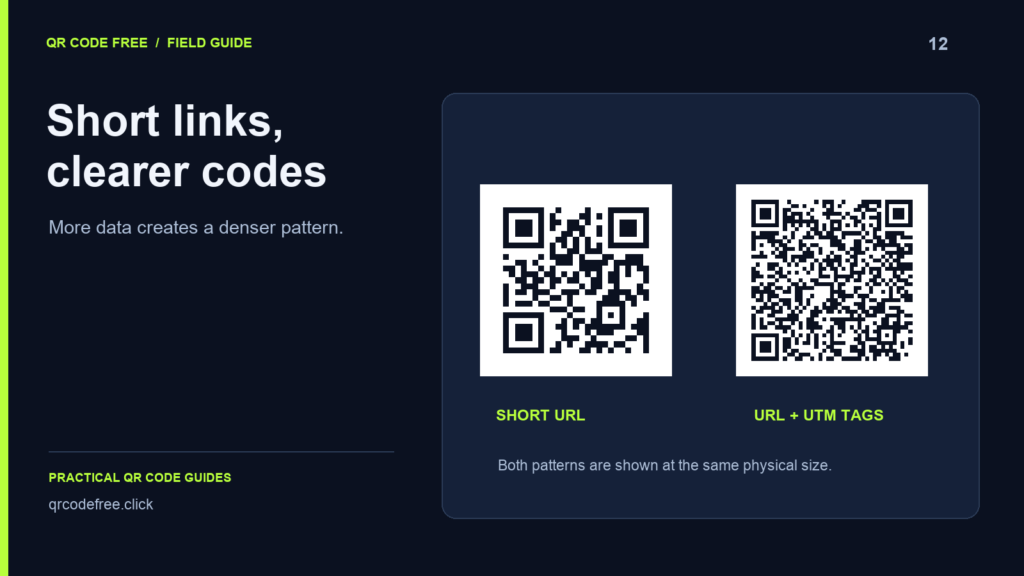
Campaign parameters can help a destination analytics system identify a visit, but they also add characters to the URL stored in a QR code. More data may require a larger pattern, which leaves smaller modules if the printed square stays the same size.
Compare complete URLs
A short example is https://example.com/m. A tracked example might append ?utm_source=poster&utm_medium=print&utm_campaign=summer. The exact resulting QR version depends on the full payload, encoding mode and correction level.
There is no reliable universal table that converts a character count into a module count for every URL. Standard QR dimensions start at 21 modules and increase by four per version.
Run a useful comparison
- Enter the untracked URL in the generator.
- Keep correction level, output size, colours and style fixed.
- Record the displayed Modules value.
- Add the intended campaign parameters and compare again.
- Download both results and test them at the same final physical size.
The illustrations on this page compare real encoded example patterns, rather than promising a specific scan distance. A visually denser pattern is a reason to check size and readability, not proof that it cannot scan.
Use a stable short address when appropriate
If you control the destination domain, you may be able to print a short URL and configure a redirect to a tracked destination. That puts maintenance responsibility on your website. Test that redirects work and that the destination analytics records the campaign as intended.
A QR image itself does not provide analytics. External redirect services may have their own pricing, data practices and continuity risks. Understand those before depending on a service for a long-lived printed code.
Do not sacrifice the border
Keep at least four modules of quiet zone on every side. If the tracked version is harder to read, enlarge the physical code, reduce unnecessary parameters or use a stable shorter address. Scan the final file and a physical sample on multiple phones.
Reference: DENSO WAVE: QR dimensions and capacity. See static versus dynamic links.